


Our Services
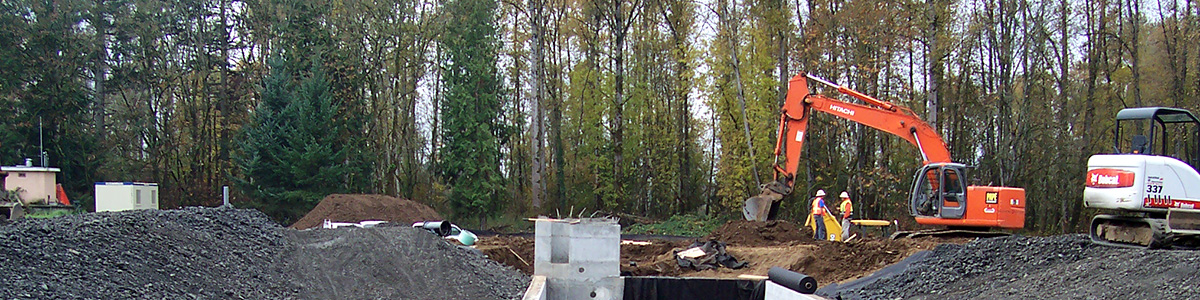
From bridges and highways, to pump stations and reservoirs... Landis & Landis Construction has built a strong reputation for expertise in the heavy/highway and site development construction sectors. We deliver quality work that starts with planning, and continues through all phases of construction — until your project is complete.
Landis & Landis Construction has a reputation and proven history for taking on some of the most challenging infrastructure projects in the Pacific Northwest. With our experience, dedication and capability, we have successfully completed many projects ahead of schedule.
Construction Management
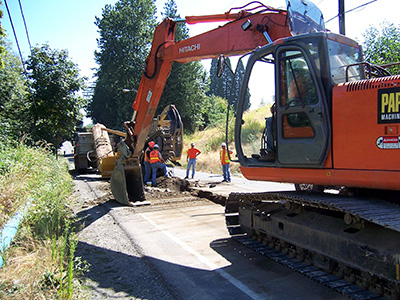
We perform the majority of our work as a General Contractor due to our proven track record of being able to meet project commitments. Our self-performance capability in various disciplines enhances our ability to manage and direct project costs, schedule and overall construction quality.
As your General Contractor for your next project, Landis & Landis will provide you with responsive leadership and management throughout the project duration, from groundbreaking to closeout.
Please contact us for additional information.
Design/Build
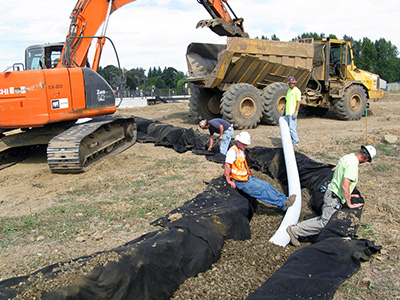
Based on our relationships with architects, engineers, consultants, material suppliers and subcontractors, Landis & Landis is able to form successful design-build teams to meet the needs of our clients.
The value that Landis & Landis adds to a Design-Build project team is in our vast project experiences, our knowledge of the work, our capability to review designs for constructability, and our cost estimating experience.
By adding our experienced construction professionals during the planning and design processes, we are confident that we are resolved to provide alternatives for saving you time and money.
Please contact us for additional information.
Engineering
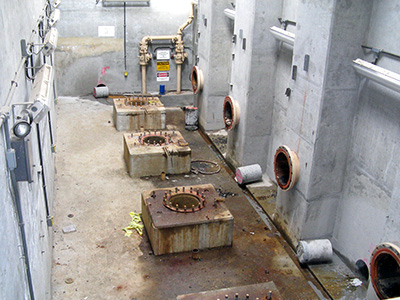
Our reputation and success has become the basis for other General Contractors and Construction Managers to solicit subcontract quotes for our services.
The same level of excellence that we have become known for over the past decade is provided as a service to all of our clients. We continue to seek new opportunities as a subcontractor for earthwork, utilities, sheet piling and driven pile foundations.
Please contact us for additional information.
Technology
"GPS Changing The Construction Landscape"
Portland Daily Journal of Commerce
In the next decade, global positioning system technology will be just like a laser is on a job site now, said Alan Park, owner of Vancouver's Division 2 Services, in a presentation to the National Utility Contractor's Association Tuesday night, with the technology on its way to becoming the rule, rather than the exception.
GPS, which uses an array of satellites to measure the exact position of a location on the ground, provides instant surface and volume data for stake-free grading and excavation on a job site, saving contractors valuable time and money.
You can stand anywhere on the job site, and it will tell you what the cut/fill is, said Steve Ike, GPS products manager of PPI Group, which sells the Topcon brand GPS system. GPS has been available for use on job sites for about 10 years, said Park, but the technology has only recently seen wider adoption among contractors. Rapid improvements in computing have made units smaller, more portable and job-site friendly, he said.
The availability of additional satellite networks also provides greater accuracy in the tools' measurements, Ike said. And contractors can use the improved systems on sites smaller than 30 acres, which wasn't possible with earlier models, said Matthew Gebarowski, president of Dirt Logic, a Portland company that specializes in GPS modeling and takeoffs for engineers and contractors.
It's an essential tool for tight tolerance grading, said Craig Bauld of Rain Country Construction, an Eagle Creek firm. Bauld upgraded his system two months ago from a local positioning use station to a box that feeds information to the grader from a global satellite system. We can grade within the thickness of a quarter inch over an entire 17-acre area — that's very tight.
With an initial investment of about $80,000 for a state of the art system, Bauld expects the purchase to pay off within a short time. Many contractors and industry representatives believe that GPS technology will become an essential tool as more companies adopt the technology. And with what organizers said was record attendance at the NUCA meeting, interest in GPS technology could receive a boost among Portland-area contractors who have not yet adopted it.
It's a great technology, said T.J. Landis, owner of Landis & Landis Construction. Landis purchased the GPS system for work on a one-mile stretch of boardwalk that included placing 160 concrete pier blocks every 10 feet among a maze of trees. We knew the GPS would be perfect for this type of job, because of the intricacies of the survey involved, he said. The equipment cost more up front, Landis said. But we figured to have a surveyor come out would have cost an extra four to five thousand dollars, and it saved us about three or four days.
© 2006 Dolan Media Newswires
ProQuest Information and Learning Company
All Rights Reserved.
Please contact us for additional information.